
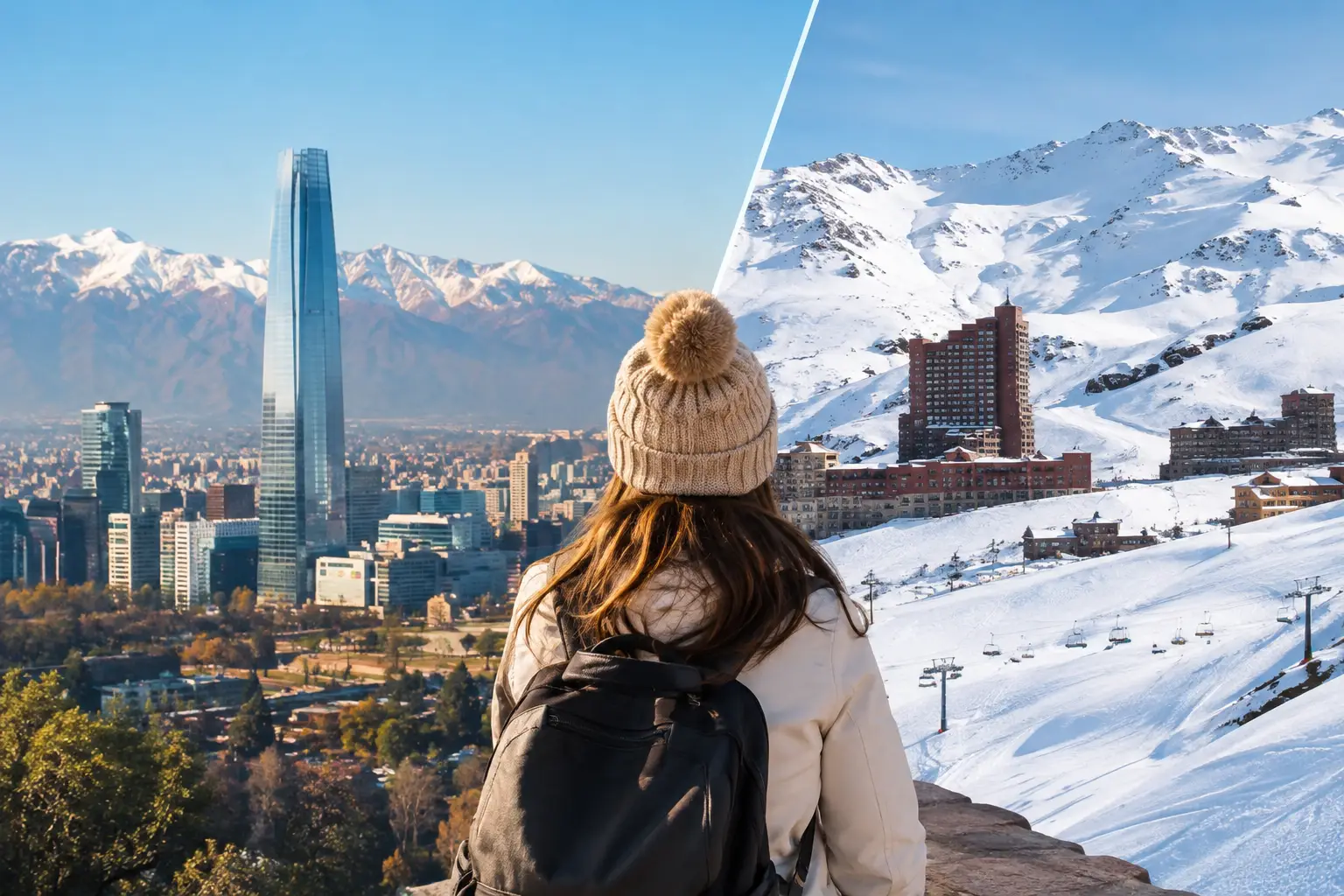
The decision between staying in Santiago or Valle Nevado completely changes the pace of your ski vacation. On the one hand, you wake up close to the restaurants, museums, and charming neighborhoods of the Chilean capital, but you have to face the climb up the mountain. On the other hand, you open the window to a view of the Andes Mountains, put on your gear, and hit the slopes in just a few minutes—with less room for the unexpected.
There’s no universally “better” choice. It depends on the number of days you’ll be skiing, your group’s profile, the time of year you’re traveling, and—most importantly—how much you value time on the slopes versus variety off the mountain. For Brazilians planning their first winter trip to Chile, understanding this difference before booking helps avoid a tiring itinerary or accommodations that don’t meet your expectations.
Staying in Santiago or Valle Nevado: A Quick Comparison
| Criterion | Accommodations in Santiago | Accommodation in Valle Nevado |
|---|---|---|
| Access to the slopes | Requires a daily shuttle to the mountain | Slopes and amenities just steps from the hotel |
| Daily Routine | Combines city life and skiing | Total focus on the snow experience |
| Travel time | May vary depending on traffic and road conditions | Virtually eliminated on ski days |
| Dining and city life | Wide variety of restaurants and activities | Options concentrated within the resort |
| Altitude | Lower altitude, easier acclimatization | Above 3,000 meters, requires attention to acclimatization |
| Best for | Those who want to explore Santiago and ski on select days | Those who prioritize skiing, snowboarding, comfort, and convenience |
The table points the way, but there are details that carry a lot of weight in practice. A three-night trip, for example, calls for different choices than a full week of vacation with children or a group trip to make the most of the snow.
When it’s worth staying in Santiago
Santiago works very well for those who want skiing to be part of the trip, not the entire trip. It’s a good base for couples who want to explore wineries, restaurants, and neighborhoods like Lastarria, Providencia, or Vitacura, while setting aside one or two days to head up the mountain.
It can also be an interesting option when your budget is tighter. The capital offers a wider variety of hotels, aparthotels, and accommodation categories. This allows you to keep accommodation and meal costs under control, especially if you’re traveling with your family or plan to enjoy urban attractions on days when you’re not skiing.
The key issue is transportation. The mountain road to the ski resorts should not be treated as a simple city commute. Under favorable conditions, you’ll need to leave early, and the route includes many curves. On days with snowstorms, icy conditions, or heavy traffic, travel time may increase, and snow chains may be required. Therefore, it’s best to rely on organized transportation, an experienced driver, and realistic schedules.
Those staying in Santiago usually have to accept a longer routine: an early breakfast, leaving before rush hour, a day on the slopes, and returning to the hotel in the late afternoon. For those who ski once or twice, this schedule usually works well. For those who plan to ski every day, it can take away valuable hours of rest and time on the slopes.
Is Santiago better for beginners?
Not always. For a beginner who will take just one lesson and wants to combine skiing with city sightseeing, Santiago is a convenient base. But if the plan is to learn over several days, staying on the mountain may be more comfortable. The proximity makes it easy to start lessons at a leisurely pace, take breaks at the hotel, and return to the slopes when you have the energy.
This makes a difference for children, for those unaccustomed to the altitude, and for adults who want to learn without turning every day into a logistical operation.
When staying in Valle Nevado makes the most sense
Staying in Valle Nevado is the natural choice for those traveling primarily to ski or snowboard. The most valuable advantage isn’t just the scenery—it’s the time. You wake up on the mountain, have breakfast, pick up or adjust your gear, and hit the slopes without having to worry about roads, traffic, or return times.
This convenience enhances the experience for those who want to catch the first run of the day, return to rest in the middle of the afternoon, or stay on the mountain when the snow and weather are especially good. For intermediate and advanced skiers, more time on the slopes tends to justify the higher cost of staying at higher elevations.
Families also tend to enjoy this benefit. With children, gloves, boots, helmets, scheduled lessons, and mood swings caused by the cold, cutting out the daily commute simplifies everything. Parents can plan the day more calmly, and the children don’t arrive at the resort already tired from the car or bus ride.
Staying at the resort also benefits those seeking a more immersive winter experience. The day doesn’t end when you leave the slopes: the mountain remains in view—in the rest areas, during meals, and at the next sunrise. It’s an especially appealing option for those dreaming of that first full-fledged snow experience, without having to rely on a short visit.
Caution Regarding Altitude
Valle Nevado is at high altitude, and your body may need time to adjust. Mild headaches, more fatigue than usual, and less restful sleep may occur during the first few days. Staying well-hydrated, eating light meals, limiting alcohol, and avoiding an overly strenuous schedule upon arrival can help a great deal.
For some people, a balanced strategy is to spend the first night in Santiago and head up to the mountain the next day. This can make the acclimatization process more gradual, especially after an international flight. Still, the best decision should take into account the length of the trip and the group’s priorities.
Cost: Consider the entire trip, not just the daily rate
In general, staying on the mountain costs more than equivalent accommodations in Santiago. However, comparing only the nightly rate can lead to an incomplete conclusion. When staying in the city, you need to factor in daily transfers, travel time, meals, admission fees or ski passes, and the cost of losing part of the day in transit.
In the mountains, the daily rate may come with amenities that reduce the need for decision-making and travel. In Santiago, on the other hand, you have more freedom to choose where to eat, where to stay, and how to plan your itinerary. Neither option is automatically more economical: the outcome depends on how many days you plan to ski and the nature of your trip.
For a couple planning two days on the slopes who also want to enjoy the capital, Santiago tends to offer a better balance. For a family seeking four or five days of skiing, lessons, and relaxation with predictable logistics, staying in Valle Nevado may offer better perceived value, even with a higher initial investment.
A third option: splitting your stay
For many travelers, the best solution isn’t to choose just one base. Splitting the trip between Santiago and Valle Nevado allows you to explore the city, go shopping, or enjoy culinary tours, and then spend a few days fully dedicated to the slopes.
This alternative works well for itineraries of six nights or more. Starting in Santiago can also be convenient for those arriving late at the airport or who prefer to rest after their flight. Then, the move to the mountains marks the start of the skiing portion of the trip, with fewer worries about schedules and driving.
The key is to avoid too many hotel changes on a short trip. If you’ll only have three or four nights in Chile, switching accommodations can take up time that would be better spent on a single, well-organized itinerary.
How to Choose Based on Your Preferences
If you want to ski every day, have young children, are traveling during a peak season, or want the most comfortable experience possible, stay in the mountains. Operational predictability is key when the goal is to make the most of every day on the snow.
If you want to alternate between skiing, wineries, fine dining, and city sightseeing, Santiago offers a more versatile base. Plan your days on the mountain in advance, check road conditions, and opt for coordinated transfers to minimize risks and uncertainties on the day of your activities.
Groups with mixed interests deserve special attention. When some members want to ski and others prefer to explore the city, Santiago can better accommodate everyone. On the other hand, when the entire group travels to the mountains, staying up there prevents non-skiers from feeling out of place and gives them the chance to enjoy the scenery, rest areas, and the resort’s atmosphere.
Frequently Asked Questions About Staying in Santiago or Valle Nevado
Is it possible to visit Valle Nevado and return to Santiago on the same day?
Yes. This is a common option for those staying in the capital. It’s best to leave early, book transportation in advance, and keep in mind that traffic and weather conditions can affect travel times.
How many days of skiing make it worth staying up in the mountains?
For three or more days on the slopes, staying in Valle Nevado usually makes sense because of the time saved and the added comfort. For one or two days of skiing, Santiago may be more convenient for combining snow and city life.
Is it better to stay on the mountain on a first trip to the snow?
It might be, especially for families and beginners who value support, lessons, and a simple routine. But those who want to experience Santiago beyond the snow will also have an excellent trip by using the city as a base and organizing their transfers well.
The final decision becomes easier once you decide what kind of memories you want to take home: days spent alternating between glasses of wine, exploring Santiago’s neighborhoods, and a trip to the snow, or mornings waking up to a view of the slopes in the Andes. With accommodations, transportation, and ski days all planned out from the start, both experiences can be unforgettable.


